2025 Annual Ranking: Which DAX CEOs set the media agenda
The Frankfurter Allgemeine Sonntagszeitung published UNICEPTA’s CEO-Impact-Ranking for calendar year 2025.
Clear annual picture: the auto industry’s structural crisis and a lasting security-policy “Zeitenwende” drive visibility.
Top three: Oliver Blume (VW) at #1, Armin Papperger (Rheinmetall) at #2, Ola Källenius (Mercedes-Benz) at #3.
Christian Sewing (Deutsche Bank) ahead of Oliver Zipse (BMW) in the top five.
19.01.2026
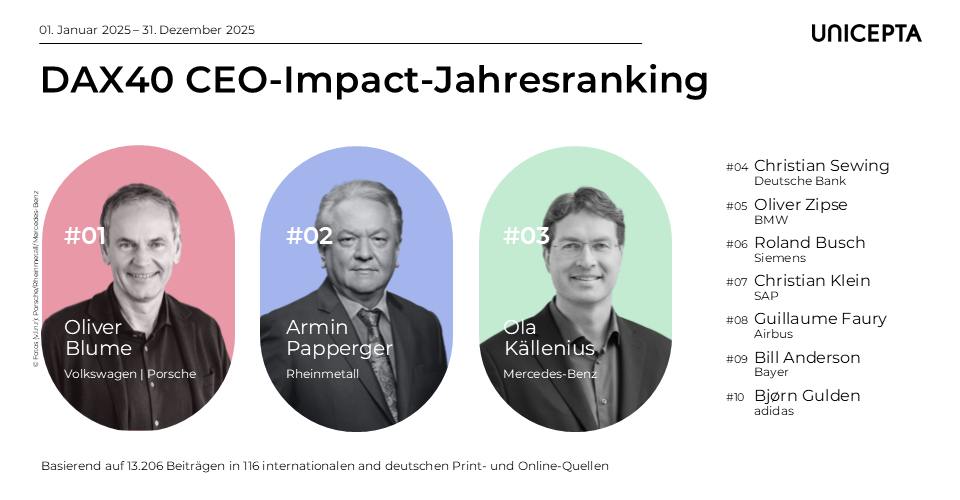
2025 was a stress test for Germany’s key industries. Autos faced structural headwinds—price pressure, weaker China demand, and a demanding shift to e-mobility—while tariffs, trade frictions, and high energy costs strained the business base; supply chains stayed fragile and investment decisions tilted toward the U.S. At the same time, companies ramped up AI-driven processes, products, and capex, as geopolitics and security concerns reshaped the agenda. Against this backdrop, CEOs from autos and defense dominated media attention. UNICEPTA’s CEO-Impact annual ranking explains which themes concentrated attention in 2025—and why.
Oliver Blume tops the ranking
Blume leads the annual list by a wide margin. Coverage frames his visibility through the auto sector’s crisis context and Volkswagen’s transformation. Bild am Sonntag quotes him: “The world is off its hinges: geopolitical crises, wars, tariffs. That affects the entire industry and, of course, us. But we are already steering successfully against it.” This set the tone for reporting focused on crisis environment, course correction, and market prioritization.
His dual role at Volkswagen and Porsche was a core storyline in 2025. WirtschaftsWoche cites him: “Responsibility was my key motivation to take over leadership of the Volkswagen Group… My dual role is important for the tasks ahead, but not for all time.” In Q4, VW announced he would step down from the Porsche post at year-end.
On e-mobility, tagesschau reports he called for a “reality check” and “flexible transition periods” for the combustion-engine phase-out—while emphasizing a “clear focus on e-mobility.” This mix of pragmatism and target state shaped debate around VW’s transformation path.
Papperger at #2, Källenius completes the top three
Rheinmetall CEO Armin Papperger ranks second. Media visibility stems from record orders, capacity expansion, and a sharpened focus on security products. Reuters quotes: “Rheinmetall is successfully on its way to becoming a global defense champion.” Bild adds forward-looking portfolio notes (NATO readiness by 2030; readiness to divest the civilian business in early 2026). Together, persistent demand, scaling, and portfolio focus explain his high profile.
Mercedes-Benz CEO Ola Källenius rounds out the top three. In Der Spiegel, he strikes a confident tone on Germany as an industrial base and stresses the state’s role in enabling the mobility transition: “I see much that is encouraging in the coalition agreement… growth as a prerequisite for everything we want to do.” His 2025 visibility was driven by regulation and transformation debates. FOCUS quotes: “We need to adjust regulations pragmatically to achieve three things: decarbonization, economic strength—and connectivity.” In USA Today he adds the reality check on a combustion ban: “We have to face reality. Otherwise we are heading full speed into a wall.”
Christian Sewing #4, Oliver Zipse #5
Deutsche Bank’s Christian Sewing combined results with restructuring. On his contract extension he looked ahead: “There are so many opportunities out there… the next phase of our development will be about seizing them,” Reuters reports—while Bild noted the highest profit since 2007 in Q2/H1. He also positioned himself in policy debates on growth and competitiveness.
BMW’s Oliver Zipse stood for a clear view on technology and Germany as a business location. In Bild am Sonntag he argued that “technology neutrality is the key” to innovation, competitiveness, and effective climate protection. Weeks later BMW announced a CEO change effective May 2026, increasing attention. He also underscored location and trade issues: tagesschau.de highlighted low energy prices as a central priority, while bild.de quoted his stance on tariffs: “Every tariff is one too many; citizens of the levying country always foot the bill.” IAA dynamics and cost/trade themes sustained his visibility.
Further placements (6–10): Roland Busch (Siemens, #6), Christian Klein (SAP, #7), Guillaume Faury (Airbus, #8), Bill Anderson (Bayer, #9), Bjørn Gulden (Adidas, #10).
UNICEPTA’s media-intelligence experts analyzed 13,206 articles from 116 German and international print/online sources published January–December 2025. The CEO-Impact-Ranking is based on the UNICEPTA DAX Benchmark, which continuously tracks media presence of all DAX companies and their CEOs, as well as likelihood of reception, focus, and tone.
About UNICEPTA
UNICEPTA is a global leader in media and data intelligence, empowering organizations to make smarter, faster, and more responsible decisions. Combining human expertise with AI-powered technology, UNICEPTA transforms complex information into actionable insights that drive communication, reputation, and strategy.
With more than 30 years of experience, UNICEPTA serves leading corporations, institutions, and NGOs worldwide – providing trusted intelligence that enables clients to navigate the dynamics of media, politics, and society with confidence.
Trusted Intelligence. Human-Led. AI-Fed.
Kontakt
UNICEPTA GmbH
Salierring 47-53
50677 Köln
Carlo Persico
Tel: +49 221 9902
carlo.persico@unicepta.com